
IN THIS GUIDE
One of the most common questions converters ask is whether to run copper or brass dies — and one of the most common misconceptions is that the answer comes down to price tier. It doesn’t. Copper isn’t “cheap brass,” and brass isn’t automatically “better.” Each material is engineered for a different production job, and the right choice depends on your artwork, your run, and your process — not your budget alone.
What copper dies are built for
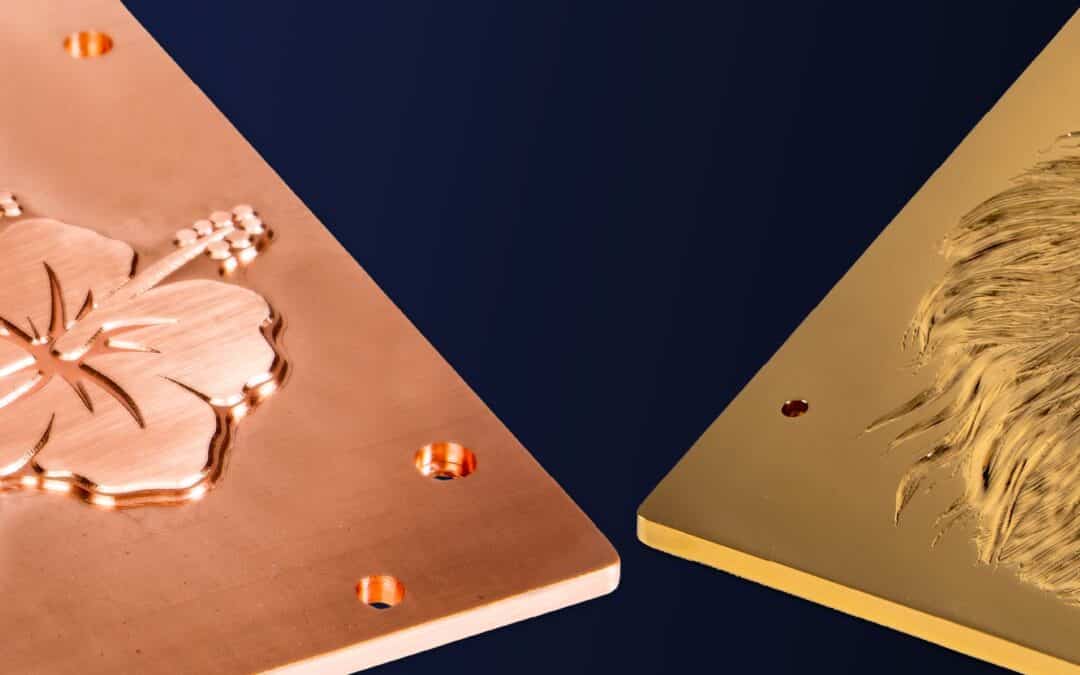
Copper dies are the workhorse for flat foil stamping, single-level embossing, Unifraxion® applications, and most standard production runs. They’re economical and faster to produce than brass, and they deliver highly consistent results for the applications they’re built for — which covers the majority of day-to-day stamping and embossing work.
What brass dies are built for
Brass is a harder, more durable material suited to deep, sculpted, multi-level embossing where fine detail retention matters and the die needs to hold up over a long production run. When a job calls for complex dimensional geometry rather than a single flat level, brass is generally the better-engineered fit — the added cost buys detail and durability the job actually needs.
The simplified rule of thumb
| Material | Best for |
|---|---|
| Copper | Efficient, versatile, high-quality production tooling |
| Brass | Premium sculpted tooling for maximum detail and durability |
Decisions that often get bundled with this one
- Etched vs. engraved processes — different manufacturing approaches with different detail and cost implications, worth its own conversation with your tooling partner.
- Embossing vs. debossing — direction of the relief, which affects both die design and press setup.
- Combination dies vs. separate emboss/foil passes — a one-pass combination die can reduce setup and registration steps, but isn’t right for every design.
- Rotary vs. flatbed tooling — largely a function of press type and run length, not die material.
A quick decision checklist
- Detail complexity: simple, flat imagery → copper. Deep, sculpted, multi-level detail → brass.
- Run length: shorter to moderate runs → copper is usually sufficient. Long production runs → brass holds up longer.
- Emboss depth: minimal to single-level → copper. Deep or multi-level → brass.
- Turnaround: need it fast → copper produces quicker. Have lead time and need durability → brass is worth the wait.
Because die material is a production-performance decision as much as a cost decision, it’s worth bringing your tooling partner in during the design stage — before artwork is finalized — rather than discovering mid-run that the die material doesn’t match the job’s detail or durability requirements.
Not sure which die material fits your job?
Bring in Universal Engraving’s technical team before your artwork is finalized.
Click Here to Talk to a Tooling Specialist
Frequently Asked Questions
Is brass always better than copper for embossing dies?
No. Brass is harder and more durable, which makes it the better fit for deep, sculpted, multi-level embossing and long production runs. But for flat foil stamping, single-level embossing, and most standard runs, copper is faster to produce, more economical, and delivers highly consistent results — it isn’t a lesser material, just a different tool for a different job.
How long do copper dies last compared to brass?
Brass generally holds up longer over extended production runs because it’s a harder, more durable material. Copper is very consistent for the run lengths and applications it’s built for, but for long-run jobs with complex, sculpted detail, brass is the more durable choice.
Can I use the same die for both foil stamping and embossing?
Sometimes — a combination die can apply foil and embossing in one pass, which reduces setup and registration steps. But combination dies aren’t right for every design; whether to combine passes or keep them separate depends on the artwork’s complexity and the effect you need.